Why Consistent Follow-Through Helps Children Learn Transitions
If you’ve ever asked your child to stop playing, clean up their toys, leave the playground, or get ready for bed only to be met with crying, running away, or a flat-out “No,” you’re not alone.
As a pediatric Board Certified Behavior Analyst (BCBA) working with autistic children, transitions are one of the biggest challenges I help families and teachers navigate. I see it every week in homes, classrooms, schools, and community settings.
The good news is that this is a very common challenge. The even better news is that research gives us helpful guidance on how children learn transition skills over time.
If you’re wondering why your child struggles with transitions in the first place, be sure to read our article, Why Transitions Hard for Some Autistic Children.
Do Transition Countdowns Help?
Many parents and teachers prepare children for transitions by giving advance notice:
- “Five more minutes.”
- “Two more minutes.”
- “One more minute.”
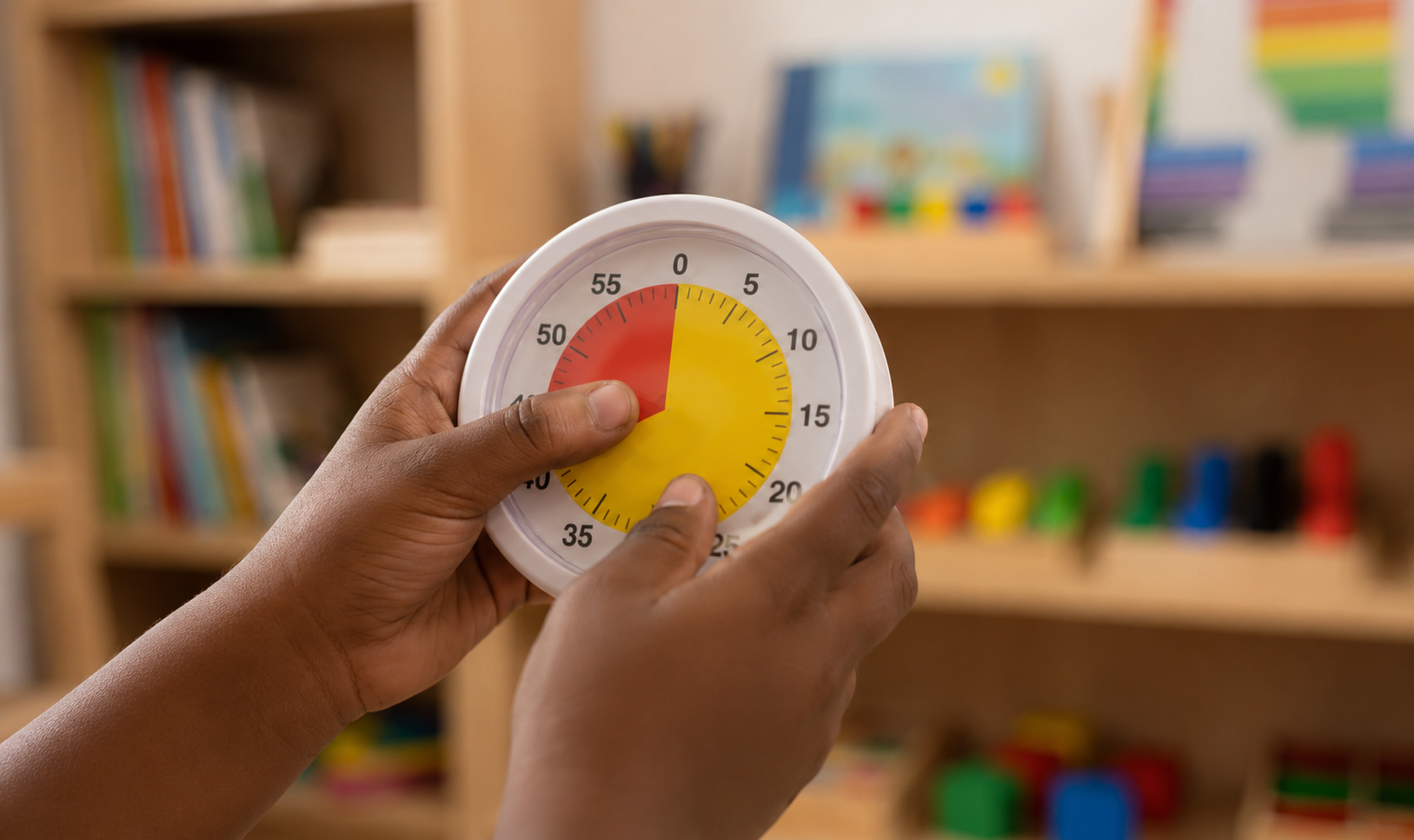
These countdowns can absolutely be helpful. I recommend them often because they give children time to prepare for what’s coming next.
But research suggests that countdowns are only one piece of the puzzle. If we want children to become more successful with future transitions, what happens after the countdown may matter even more.
What the Research Says
Researchers studied toddlers who regularly refused to stop playing and transition to diaper changes and toileting. They compared three common approaches:
- Giving a two-minute warning before the transition.
- Letting the child carry a preferred toy during the transition.
- Consistently helping the child complete the transition when it was time to move on.
The results showed that giving a transition warning by itself didn’t improve cooperation. Also, letting children carry a favorite toy by itself didn’t improve cooperation either.
The biggest improvements happened when adults consistently helped children complete the transition instead of allowing them to avoid it. For two of the children, bringing a favorite toy also helped, but only when it was paired with consistent follow-through.
The takeaway isn’t that countdowns are ineffective. Instead, the study suggests that children became more likely to cooperate over time when adults calmly and consistently helped them complete the transition.
How Children Learn Successful Transitions
This is a conversation I have with parents and school teams all the time. The goal isn’t to force a child through a transition. The goal is to teach them that transitions are a normal part of everyday life and that they can successfully move from one activity to the next.
Like all of us, children learn from patterns. If protesting sometimes delays or avoids a transition, they’re more likely to try that same strategy again in the future because it has worked before. That’s simply how learning works. We all tend to repeat behaviors that help us get something we want or avoid something we’d rather not do.
The opposite is also true. When children experience calm, predictable support during transitions, they gradually learn that although transitions may be difficult, they are manageable. Over time, that predictability helps build confidence and cooperation.
Consistency doesn’t mean ignoring your child’s feelings. You can acknowledge that leaving the playground is disappointing while still helping them move to the next activity. In fact, children often cope better when adults validate their emotions while calmly keeping the routine moving.
What Parents Often Do Without Realizing It
One thing I’ve learned after working with many families is that parents aren’t changing the plan because they don’t care.
They’re exhausted.
They’re trying to avoid a public meltdown.
They’re worried about upsetting their child.
Teachers are trying to keep an entire classroom on schedule.
Grandparents simply want everyone to enjoy their visit.
Everyone has good intentions.
The challenge is that even when we’re doing our best, children learn from repeated experiences over time. If protesting sometimes results in extra time, more negotiation, or delaying the transition, they’re likely to try that strategy again in the future.
That doesn’t mean anyone has done something “wrong.” It simply means children are learning from what happens next, just like all of us do.
What Following Through Really Looks Like
Following through doesn’t mean yelling. It doesn’t mean threatening or dragging a child through a meltdown. It means responding calmly, consistently, and predictably.
In the same research study, adults continued supporting the children through the transition while keeping the expectation the same, even when the child protested. Over time, the children became much more likely to cooperate because they learned that the expectation stayed the same.
At home, following through might look like this: It’s time to leave the playground. You give your countdown, and when the time is up, you calmly say, “It’s time to go.” If your child protests, meet them where they are. Offer your hand, use a visual schedule or countdown if it helps, and break the transition into small, manageable steps. Maybe the first goal is simply standing up. Then walking to the gate. Then walking toward the car.
Celebrate each step with specific praise. For example:
- “You stood up all by yourself.”
- “Nice job taking your first step.”
- “You’re walking with me. Great job.”
Small successes build momentum. Over time, those small steps become smoother, more independent transitions.
Celebrate the Small Wins
Transitions are a skill. And like any skill, they improve with practice. Celebrate the progress, even when it feels small. Maybe your child walked to the bathroom after one reminder instead of five. Maybe they left the playground with some whining instead of a full meltdown. Maybe they cleaned up one toy before asking for help. Those moments matter because they show your child is learning.
My Final Thoughts
One thing I hope you take away from this research is that difficult transitions don’t mean you’re failing, and they don’t mean your child is being “bad.” Transitions are simply a skill that many autistic children need more support learning.
As a BCBA, I’ve learned that smoother transitions rarely come from finding the perfect timer, visual schedule, or reward. Those tools can absolutely help, but the biggest difference happens when the adults in a child’s life work together, respond calmly, and provide consistent support.
Children thrive when they know what to expect. When home, school, and therapy all send the same message with patience, empathy, and consistency, children become more confident navigating everyday transitions.
It won’t happen overnight, and it won’t be perfect every time. But with enough supportive practice, today’s difficult transitions can become tomorrow’s routine successes.
About the Author
Krysten Clark Wilkes, M.A., BCBA, LBA is a Board Certified Behavior Analyst and founder of Learning & Behavior Autism Services. She works with autistic children and their families throughout Maryland, helping children build communication, independence, social, and daily living skills through evidence-based, family-centered support.